
The Gemist Hub Academy
Glossary
The words behind the craft, in plain language — enamel, bonding, candidacy and the standards that sit around them.
42 terms, defined plainly.
Definitions only — never instructions. The how is what the Academy is for; the why and the what are free, always.
- Acid-etch bonding
- A reversible dental technique in which a mild phosphoric-acid gel is applied to enamel for a few seconds to create microscopic texture, then rinsed away, so a resin can grip the surface. It is the same conditioning step used before fillings and orthodontic brackets, and does not remove meaningful enamel.
- Bioburden
- The number of live microorganisms present on a surface or instrument before cleaning and sterilisation. Lowering bioburden is the first step in every infection-control routine.
- Biocompatible bonding
- Bonding materials that do not harm living tissue — the standard tooth-gem adhesives are drawn from the same class used in orthodontics, designed to sit safely on enamel.
- Bruxism
- Involuntary grinding or clenching of the teeth, often during sleep. It is one of the factors a candidacy conversation considers before a gem is placed.
- Candidacy assessment
- The honest, structured process of deciding whether a tooth gem is appropriate for a particular person — and whether now is the right time. It can, and should, sometimes answer no.
- Chair rent
- A business arrangement in which a professional rents chair time or a treatment room inside an established salon, rather than owning a studio outright.
- Chair utilisation
- The share of available chair time that is actually generating revenue. In a studio business it is one of the few numbers that explains everything else.
- Clean field
- The controlled work area around the client during a placement — kept free of contamination and treated as the boundary of the sterile routine.
- Client lifetime value
- The total revenue a single client brings across the whole relationship — one gem today, a removal, a new design, a whitening, and the referrals they carry. It is why the honest consult pays for itself.
- Consultation
- The conversation before any placement — the client's history, habits and expectations, read together with the teeth themselves. The gem is designed in this conversation, not after it.
- Consultation moment
- The point in a client's journey where the conversation about a gem actually happens — often not the first visit, and never a surprise add-on.
- Consultation protocol
- The structured set of questions and checks a technician runs before every placement — history, contraindications, expectations, aftercare. The same order every time, so nothing is missed.
- Content-to-booking pipeline
- The journey from someone reading an article to someone sitting in the chair — the bridge every piece of content is built to carry, honestly and without tricks.
- Contraindication
- A condition or circumstance that makes a procedure inadvisable for a particular person. A gem is not right for everyone — identifying contraindications honestly is a core part of the craft.
- Curing light
- A handheld dental lamp that emits a specific wavelength of blue light to harden (cure) composite resin on demand. It lets an applicator position a gem while the adhesive is still soft, then set the bond in seconds.
- Demineralisation
- The loss of minerals from tooth enamel — the earliest stage of decay. Healthy, fully mineralised enamel is the surface every placement decision starts from.
- Dental midline
- The vertical centre line of the smile, running between the two upper front teeth. Gem placements are composed relative to it — symmetry is a decision, not an accident.
- Enamel
- The hard, mineralised outer layer of a tooth and the most durable tissue in the body. Tooth gems bond to enamel because it can be safely conditioned and polished; because enamel has no nerves, surface bonding causes no sensation.
- Enamel hypomineralisation
- Enamel that formed with lower mineral content than normal, often appearing as cloudy or chalky patches. It changes how a tooth should be read before anything is bonded to it.
- Facet geometry
- The angles and cuts of a crystal's facets — the geometry that decides how light returns to the eye. It is why two same-sized gems can read completely differently on the tooth.
- Flowable composite
- A thinner, more fluid version of light-cured composite resin that uses the same chemistry but sets to a lower profile. It suits small or curved gems where a slimmer bond is wanted, typically holding for three to twelve months.
- Gingival recession
- The gum margin pulling back from the tooth, exposing more of the root surface. It is one of the things a candidacy read looks for before placing anything.
- Glass-ionomer cement
- A dental cement that bonds chemically to enamel and slowly releases fluoride. It is gentler than composite resin but forms a weaker hold, so it is generally reserved for temporary tooth-gem placements lasting weeks to months.
- Hydroxyapatite
- The calcium-phosphate mineral that makes up the bulk of tooth enamel. 'Enamel-safe' techniques are ones that respect this structure — nothing is drilled or etched away unnecessarily.
- Informed consent
- A client agreeing to a procedure with a genuine understanding of what it involves, how it will feel, and what the honest risks and limits are. It is a conversation, not a signature.
- Isolation (dry field)
- Keeping a tooth clean and completely dry during application, using cheek retractors, cotton or an air stream. Moisture reaching the bond is the single most common reason a gem fails early, so a controlled dry field is essential to a lasting, safe result.
- Light-cured composite resin
- A tooth-coloured dental resin that stays soft until a curing light hardens it in seconds. It is the clinical-standard adhesive for tooth gems, forming a small, controlled bond footprint that holds for six to eighteen months and buffs away cleanly on removal.
- Negative space
- The empty area around and between elements of a design. In a gem layout, the quiet teeth are as composed as the gemmed ones — restraint is the design.
- Placement
- The act of bonding a gem to the outer surface of the enamel — a surface-level process, with nothing drilled or embedded. In this craft, placement is the final step of a much longer process.
- Plaque margin
- The thin border where a tooth gem meets the enamel, which can trap plaque if not cleaned well. Keeping this margin clean with daily brushing and routine dental visits is what prevents gum irritation and decay around a gem.
- Remineralisation
- The natural process by which minerals such as calcium and phosphate are redeposited into enamel, helped by saliva, fluoride and calcium-phosphopeptide products. It can reverse early white-spot lesions before they become permanent, which is why aftercare around a gem matters.
- Retention
- How well and how long a bonded gem stays in place. It is decided by the same factors as the bond itself — surface, material, technique and the client's habits.
- Saliva flow rate
- How quickly a client produces saliva. Moisture control is a practical reality of bonding — a dry, clean surface is where a bond behaves predictably.
- Service recovery
- How a studio responds when something goes wrong — a loose gem, a repair, a disappointment. Done honestly, it is where trust is actually built.
- Shade guide
- A reference set of tooth shades used to match colour accurately — for whitening conversations and for choosing gems that sit with a smile rather than against it.
- Single-use instruments
- Tools used once and discarded, rather than re-sterilised. Combined with sterilised multi-use instruments and a clean field, they close the infection-control loop.
- Smile line
- The line traced by the lower edge of the upper teeth when a person smiles. Gem compositions are built on and around it — it is the canvas.
- Sterilisation indicator
- A marker that visibly changes once sterilisation conditions have been met, proving the load actually reached temperature and time. It is how a clean-station protocol is verified, not assumed.
- Thought leadership
- Content that earns authority by answering real questions completely — the opposite of content that just sells. For this craft it means teaching the why and the what before ever mentioning the how.
- Tooth gem
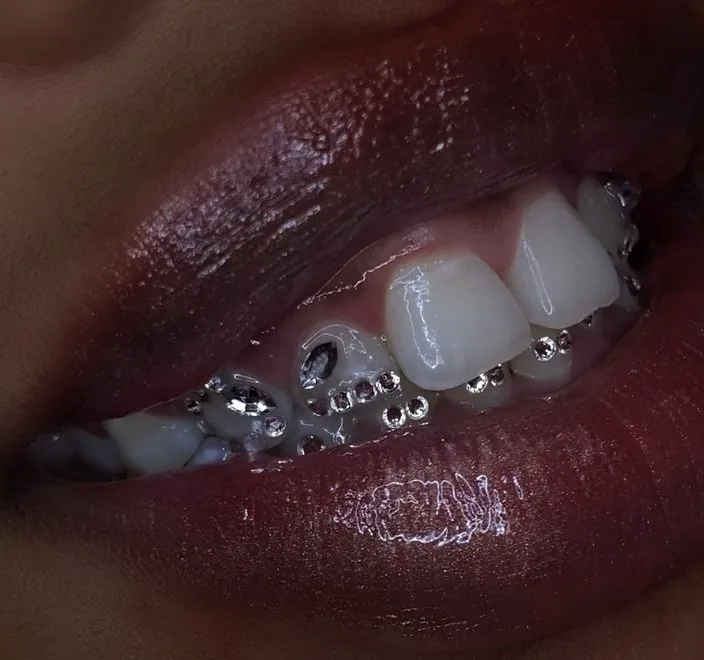
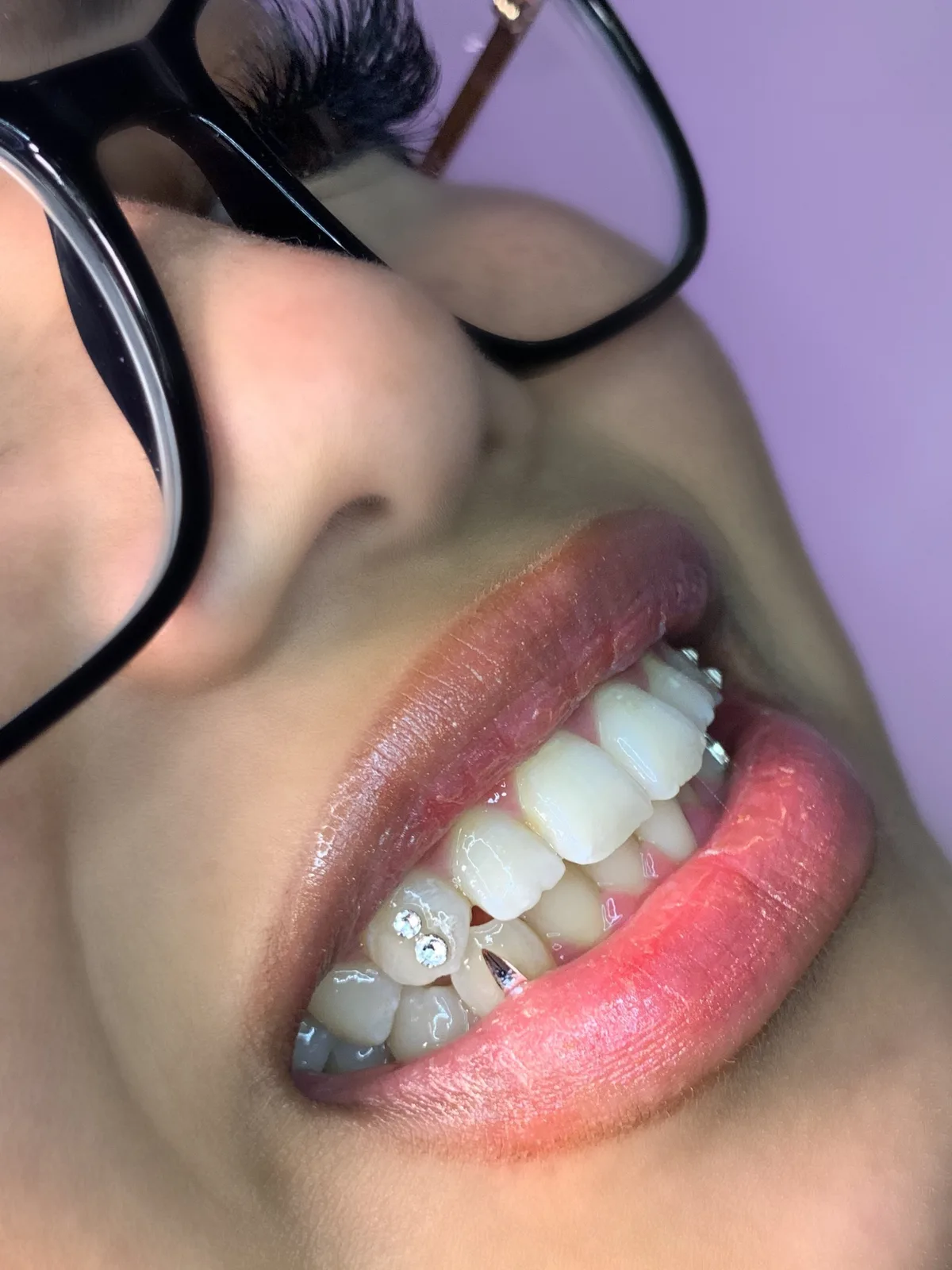
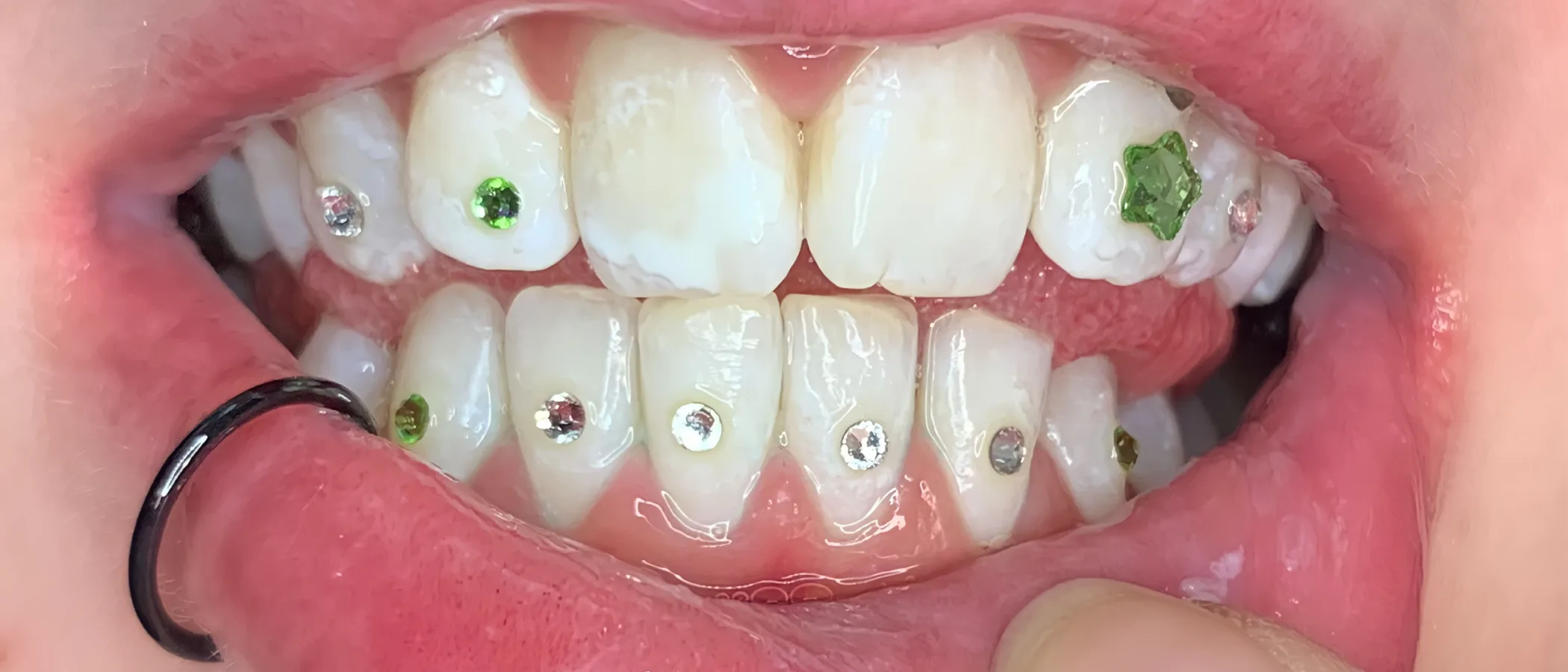
- A small crystal or gold ornament bonded to the outer surface of a tooth's enamel for cosmetic effect. It sits on top of the enamel — nothing is drilled or embedded — and is fully reversible when applied and removed by a trained applicator.
- Warranty window
- The period in which a technician stands behind their work — typically covering re-setting or repair of a gem placed by them. The terms are agreed plainly before placement, never after.
- White-spot lesion
- An early, chalky patch of demineralised enamel that can form where plaque is left to gather around any fixed object, including the margin of a tooth gem. It is preventable with good daily cleaning and, if caught early, is often reversible through remineralisation.
Keep going
The glossary is the free tier.
The craft is the Academy.
Read the reading room, take the candidacy self-assessment, and when the why and the what are yours — the how is a six-week conversation.